
Taken from The Primitive Methodist Magazine
Mr George Barrett was born at Aldbourne, Wilts, January 1st 1808. His parents were righteous before God. Their prayers, tears, and admonitions were a check to his propensities, and contributed towards the restraining of George from yielding to those sins which are too frequently indulged in by young men; hence he became subject to pious impressions. His father states that he never remembers having heard him utter an oath or tell a falsehood. His situation in life necessitated him to leave home, yet he never forgot the family altar, the reading of scriptures, nor the earnest aspirations pr4esented to the throne of grace on his behalf. He eventually married, and the union proved a happy one. They had many children, who with pleasing recollections recount the kindness and prayers of their departed parent.
At the time of their marriage, George anbd his partner in life joined the Primitive Methodist Connexion, and he earnestly sought and found Jesus, the Friend of sinners. His sense of guilt was not so distressing as is the case with some. Being influenced by the good Spirit of God, his mind gradually opened to Divine things, and he was led into faith and the favour of God without experiencing that ecstatic joy which many feel; but he went to Jesus, and felt joy and peace through believing.
In the year 1833 he was considered competent, bu the church, to call sinners to repentance. God honoured him in the conversion of souls. About this time he removed to Woodsend, in the parish of Aldbourne; and very soon, in that hamlet, God poured out his Spirit, and a gracious revival succeeded. Brother Barrett was very useful in leading mourners to Jesus, which work he was peculiarly adapted for. His kind manner in prayer-meetings, his method of directing penitents to the Saviour, secured for him thge esteem of many. The cross of Christ was his glory. His Language was
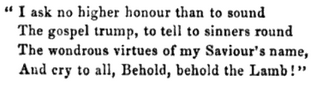
In the year 1837 he removed to Nacpin, in the parish of Chiseldon, in the Brinkworth circuit, at which place he became the leader of an important class, which office he veru efficiently filled. His occupation was that of a shapherd, which employment abridged his usefulness; notwithstanding, he attended appointments in the Shefford, Faringdon, and Brinkworth circuits with success, and many will be the crown of his rejoicing at the last day.
To enable him to attend to this blessed work, the wife of his youth not unfrequently might be seen as a shepherdess keeping wath over the flock, accompanied with one or more of their children, while this servant of God was gone, as a herald of mercy, to publish glad tidings to a guilty world.
For many years our dear brother laboured on, through many persecutions and afflictions, preachig the word at camp-meetings in the above-named circuits and elsewhere, and was made very useful. His talents were respectable; but in the midst of his usefulness it pleased God, in a very painful manner, to lay his hand upon him, in the spring of 1856. The disease from which he suffered was the softening of the spinal cord, which disease produced excruciating pain. For many weeks sleep departed from him, but the grace of God supported him. After suffering for several months he began to rally a little, and his family entertained a hope that he would recover; at least he was so far recovered that it was deemed prudent to remove him to the hospital at Bath, which a hope to establish his health; but this was overruled, by that God which cannot err. He remained there for ten weekes, and then was brought home again apprantly better; but the appearance was delusive, he returned home to sicken and die. During his protracted and painful affliction “in patience he possessed his soul;” every stroke was sanctified. At intervals when the pain subsided, his converse was on the love of Jesus to him and to a lost world. It was a priviledge to see his resignation and patience under his uncommon affliction. The writer’s sould has often been blessed in visiting him and in hearing his expressions of gratitude and praise to the God of all grace. The Influence that filled the place a few days before his death, when we were present with him, will not soon be forgotten. Jesus was his theme in life, and on his near approach to death his Lord was still more precious. He continued in a happy state till within a short time of his death, when the power of speech was taken from him; yet by signs and expressive looks he indicated that all was right. His death was peaceful as his life had been useful; and now his happy spirit is among the number of the redeemed in the paradise of God.
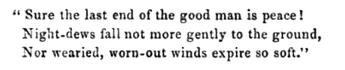
Thus our dear brother exchanged mortality for life on Tuesday, July 28th, 1857. The esteem in which he was held, and the affection with which his memory was cherished, were evidenced by the majority of the members of our society and the numerous friends who assembled at the funeral, and by the tears which were shed when the coffin was lowered into the grave.
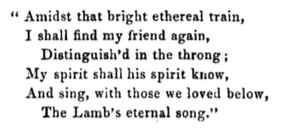
John Tarrant.
